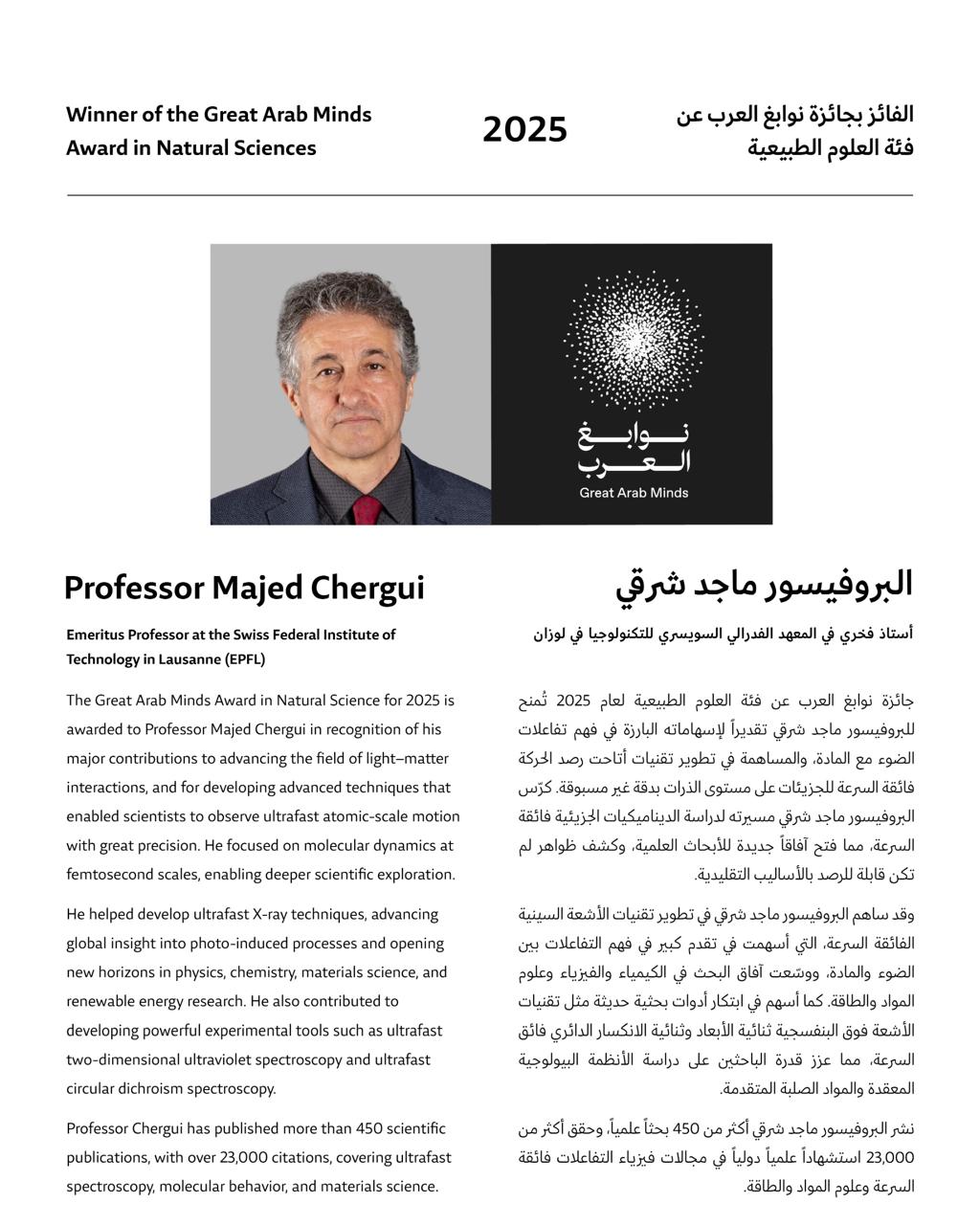
Mohammed bin Rashid congratulates winner of Great Arab Minds 2025 Award in Natural Sciences
DUBAI, 17th December, 2025

His Highness Sheikh Mohammed bin Rashid Al Maktoum, Vice President, Prime Minister and Ruler of Dubai, congratulated Professor Majed Chergui on winning the Great Arab Minds 2025 Award in the Natural Sciences category.
His Highness emphasised the importance of Arab scientific research and achievements in advancing societies, noting that science has long been a cornerstone of the Arab world’s cultural and civilisational progress.
In a post on X, His Highness said, “Civilisations are not sustained by past achievements. They renew their place in the world through the scientists of today. We congratulate the winner of the 2025 Great Arab Minds Award in Natural Sciences, Professor Majed Chergui, Emeritus Professor at the Swiss Federal Institute of Technology, who has made pioneering contributions to capturing ultrafast motion at the atomic scale.
His Highness added, “Professor Majed Chergui dedicated his scientific career to developing tools and experimental methods that enable scientists to observe the movement of molecules and materials with unprecedented femtosecond precision. He played a key role in advancing ultrafast X-ray techniques, published more than 450 scientific papers, and has received over 23,000 citations worldwide. His work has established him as one of the most influential figures in ultrafast spectroscopy, materials science, and energy.
“Congratulations to Professor Majed Chergui on this achievement. And to those who believe that Arab scientific creativity belongs only to the past, the Great Arab Minds Award stands as proof that our present is home to figures who are no less impactful, no less accomplished, and no less ambitious.”
The 2025 Great Arab Minds Award in Natural Sciences was awarded to Professor Chergui, Emeritus Professor at the Swiss Federal Institute of Technology in Lausanne (EPFL), in recognition of his outstanding contributions to the study of light–matter interactions. His work has enabled scientists to observe ultra-fast motion in molecules and materials at the atomic scale with unprecedented precision.
Professor Chergui has dedicated his scientific career to exploring molecular dynamics that occur over extremely short timescales, opening new experimental approaches in chemistry and revealing phenomena that were previously inaccessible using conventional methods.
He has played a key role in the development of ultra-fast X-ray techniques, advancing understanding of how light interacts with matter and expanding research possibilities across chemistry, physics, materials science, and renewable energy.
Professor Chergui has also pioneered modern research tools, including two dimensional ultraviolet spectroscopy and ultra-fast circular dichroism, enhancing scientists’ ability to study complex biological systems and advanced solid materials.
He has published more than 450 scientific papers and recorded over 23,000 citations worldwide in the fields of ultrafast interaction physics, materials science, and energy. He has served on numerous international scientific committees, was Editor-in-Chief of the Journal of Chemical Physics published by Elsevier, and founded the Journal of Structural Dynamics of the American Institute of Physics.
Among his most notable innovations is the ultra-fast X-ray spectrometer, which captures signals with femtosecond-level resolution and provides access to previously unexplored spectral regions. This instrument is particularly suited to the study of wide bandgap transition metal oxides.
Professor Chergui currently focuses on the use of nonlinear X rays to study solar materials, leveraging their ability to observe charge motion and propagation in solids in real time.
He continues to contribute to the development of X-ray free-electron lasers (XFEL), which have advanced nonlinear optics and spectroscopy since their emergence in the early 2010s in the United States, Japan, Italy, Germany, Switzerland, and South Korea. His work has demonstrated the value of these technologies in the study of metal oxides.